


Galapagos Guide + Best Discounts

By Fleet Captain James, 6 Star 4 Less

Galapagos Guide + Best Discounts
- Why the Galapagos
- Why this one is different from Antarctica and the Kimberley
- When to go
- How to get there
- The park rules and why they shape everything
- Typical itineraries
- Life onboard
- All about pangas
- Wildlife
- The weather
- What to pack
- Which are the best cruise lines
- Which ships
- Other operators
- Mistakes people make
- Full retail pricing
- How to secure the best discounts
- Solo travellers
- How to book
Why the Galapagos
There is no other place on earth where the wildlife has not learned to be afraid of you.
That is the whole thing. That is what people come home talking about. A sea lion pup will flop over your feet on the beach and go back to sleep. A mockingbird will land on your hat. A blue-footed booby will carry on with its courtship dance a metre from your boots and never once look up. Everywhere else on the planet, animals run. Here they do not, because for most of their history nothing ever hunted them.
Darwin worked out what that meant, and the islands have been quietly rearranging how people see the world ever since.
I want to be honest with you from the start. I have written guides to Antarctica and the Kimberley, and both of those are about scale. Ice the size of cathedrals. Cliffs that fall a thousand feet into a turquoise sea. The Galapagos is not that. The Galapagos is intimate. It is small, close, and personal, and it will get under your skin in a completely different way.
I've written this Galapagos Guide + Best Discounts to help ensure you can secure what will be one of the most epic adventures of your life at the lowest possible price.
Want to jump straight to Galápagos expedition voyage fares? Visit my Galápagos Price Index for a weekly wrap-up of which cruise lines and months are currently offering the lowest fares.
Want to super charge your experience - join me on my hosted cruise 28 February 2028. Full details here.


Why this one is different from Antarctica and the Kimberley
If you have read my other guides, put some of what you learned aside.
Antarctica and the Kimberley are the same commercial story wearing different clothes. Big 6-star expedition ships, heavy discounting, and my job is getting you onto a Seabourn or a Silversea for a fraction of what the brochure says. The Galapagos does not work like that, and any agent who tells you otherwise has not sold it.
Here is what actually changes.
The ships are tiny, and they have to be. Ecuador's National Park caps passenger numbers hard. Nothing over 100 guests operates in the islands. Most vessels carry between 16 and 100. There is no 200-passenger flagship equivalent, so the argument I make so happily in the Kimberley (our ship is bigger, better and cheaper than the little local boats) simply does not apply. In the Galapagos everyone is on a small ship. The question is which small ship.
*Your itinerary is fixed, and the park fixes it. In Antarctica nothing is scheduled and the captain chases the weather. In the Galapagos every vessel is issued an itinerary by the National Park, site by site, day by day, and it cannot be changed on a whim. Two ships are not permitted at the same landing site at the same time. This is why you must look closely at which islands your particular sailing actually visits, because unlike Antarctica, what is on the paper is what you get.
A licensed naturalist must be with you at every landing. Not a nice-to-have. The law. You cannot wander off on your own anywhere in the park. The ratio is capped at 16 guests per guide, which is why the quality of the guiding matters more here than almost anywhere else I sell.
The discounts are thinner. I will not dress this up. The deep 70 and 80 percent discounts I chase for you in the Kimberley and Antarctica are not the norm here. Galapagos ships sail full, the capacity is capped by law, and the lines know it. There is still real money to be saved, and I will show you where, but go in with your eyes open.
And you pay the park. Every visitor pays a National Park entry fee, plus a transit control card. These are not included in your cruise fare. Budget for them, and expect them to rise, because they have been rising.
When to go
Good news. There is no bad time.
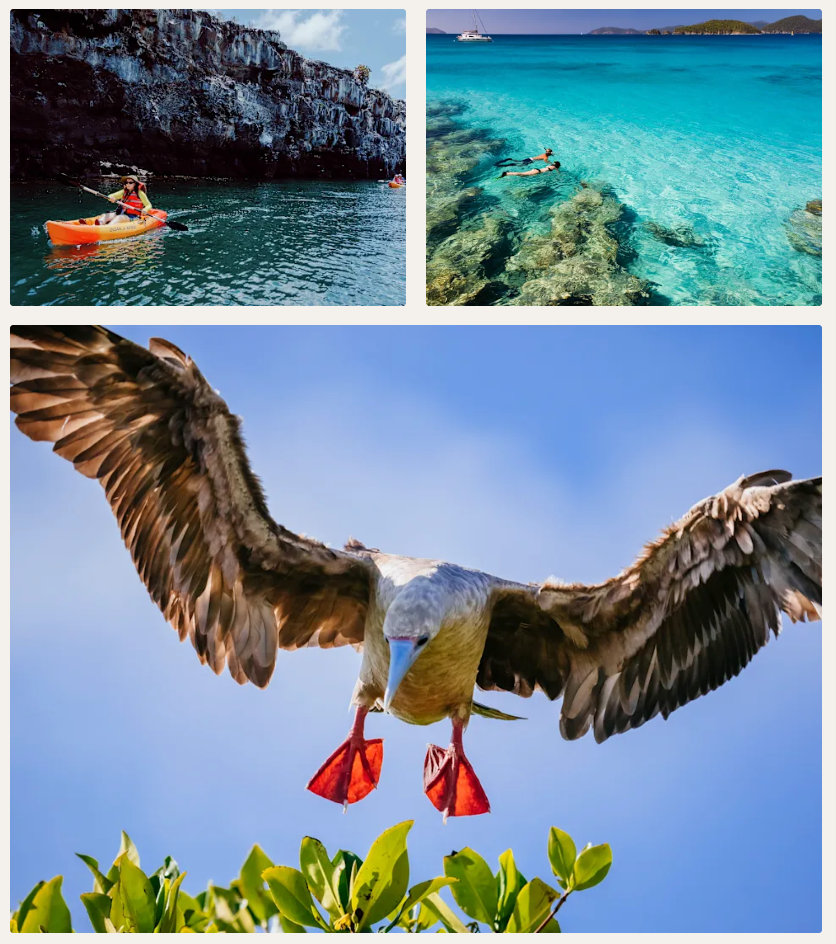
The Galapagos sits on the equator and it is a year-round destination. Nothing shuts down, nothing migrates away, and there is no wet season that makes the place unworkable the way The Wet does in the Kimberley. What you get instead is a choice between two quite different moods.
The warm season, roughly December to May. The air is warm, the sea is warm, and the water is calm and clear. There are short sharp bursts of rain that clear quickly and leave the islands green. This is the best time for snorkelling because visibility is at its best and you will not need much of a wetsuit. It is also when the land birds are breeding and the islands look their most alive. It is peak, and the fares show it.
The cool season, roughly June to November. The Humboldt Current pushes cold water up from the south and everything changes. The seas get choppier, the air cools, and a low grey mist called the garúa sits over the highlands. It sounds miserable and it is not. The cold water brings nutrients, the nutrients bring fish, and the fish bring everything else. This is when the marine life is at its most spectacular. It is also when the water is properly cold and you will want a wetsuit.
In a nutshell. If you want warm calm water, easy snorkelling, and green islands, go December to May. If you want the biggest wildlife action in the water and you do not mind a chop and a chill, go June to November. The shoulders at either end are usually the better value.
The bottom line, same as the Kimberley: it does not much matter when you go. Just go.
How to get there
Everything runs through Ecuador.

You fly into either **Quito** or **Guayaquil** on the mainland, overnight there, then take the short flight out to the islands the following morning. Most of my Galapagos sailings depart from one of these two gateways, and a handful run out of **Lima** in Peru for people combining the islands with Machu Picchu.

Take the extra night. Do not fly in on the day. This is the same advice I give for the Kimberley and for the same brutal reason. If you miss the ship in the Galapagos, there is no next port to catch it at. There is no chasing it down the coast. It is gone, and so is your fare.
**Quito** is high, and I mean properly high, at around 2,850 metres. If you have any history with altitude, factor that in and take it easy for the first day. The old town is a UNESCO site and it is worth a day of your time. **Guayaquil** is at sea level, hotter, and more of a working port city. If altitude worries you at all, route through Guayaquil.
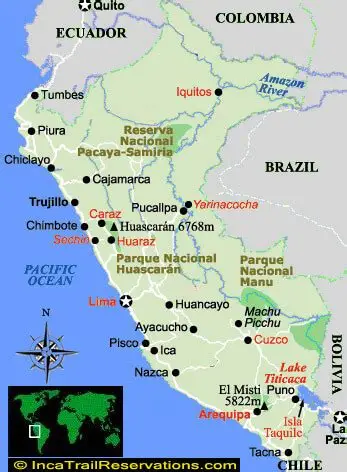
If you have the time and the budget, the Galapagos pairs beautifully with Peru. You are already most of the way there and Machu Picchu is truly once in a life time.

If you don't go while in South America to see the Galapagos Islands, chances are high you may not get another chance.
The park rules and why they shape everything
I said it above and I will say it again, because more people are caught out by this than by anything else.
The Galapagos National Park controls what your ship does. Not the cruise line. Not the captain. The park.
Every vessel is assigned a fixed itinerary. Sites are allocated so that two ships never land at the same place at the same time, which is how they keep the experience feeling wild when there are actually a lot of visitors in the archipelago. It works, and I am glad it works, but it has consequences for you.
**It means you must read the itinerary.** In Antarctica I tell people to go in with no fixed expectations because everything changes. In the Galapagos, the opposite. What the itinerary says is what you will see. If you have your heart set on the waved albatross on Española, or the red-footed boobies on Genovesa, or the western islands for the flightless cormorant and the penguins, check that your specific sailing actually goes there. Two ships from the same cruise line, sailing the same week, can visit completely different islands.
It means the naturalist is not optional. You go ashore in a group, with a licensed guide, and you stay on the marked trail. That is the deal.
It means capacity cannot grow. Which is exactly why the deep discounting I find you elsewhere is harder to find here.
Typical itineraries
Most Galapagos voyages run between about six and eleven nights, with a few longer combination sailings that add mainland Ecuador or Peru.

The shorter ones, roughly six to eight nights, will cover either the eastern and central islands or the western ones. You will see a lot, and for many people it is enough.
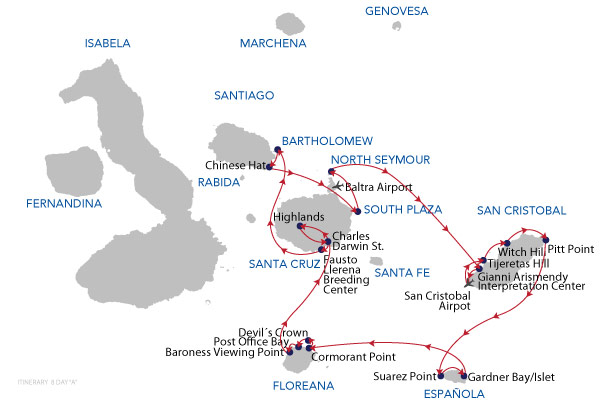
The longer ones, nine nights and up, are where you start covering enough ground to see the real variety, including the more remote outer islands. If your budget and your leave allow it, go longer. The islands are surprisingly different from one another and the short itineraries can only show you a slice.
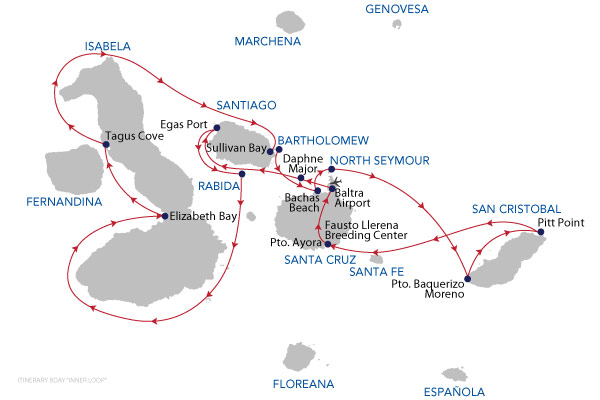
Then there are the big combination voyages, and these can run to sixteen nights or more. These are the ones that pair the islands with the mainland or with Peru.
Life onboard
Small ship. That is the headline, and it colours everything.
You will not find a casino, a theatre with a cast, or twelve restaurants. What you get instead is a handful of people, a naturalist team you will actually get to know, and a rhythm of two excursions a day with briefings and lectures in between. Dinner will be one room, and by the third night you will know everyone in it.
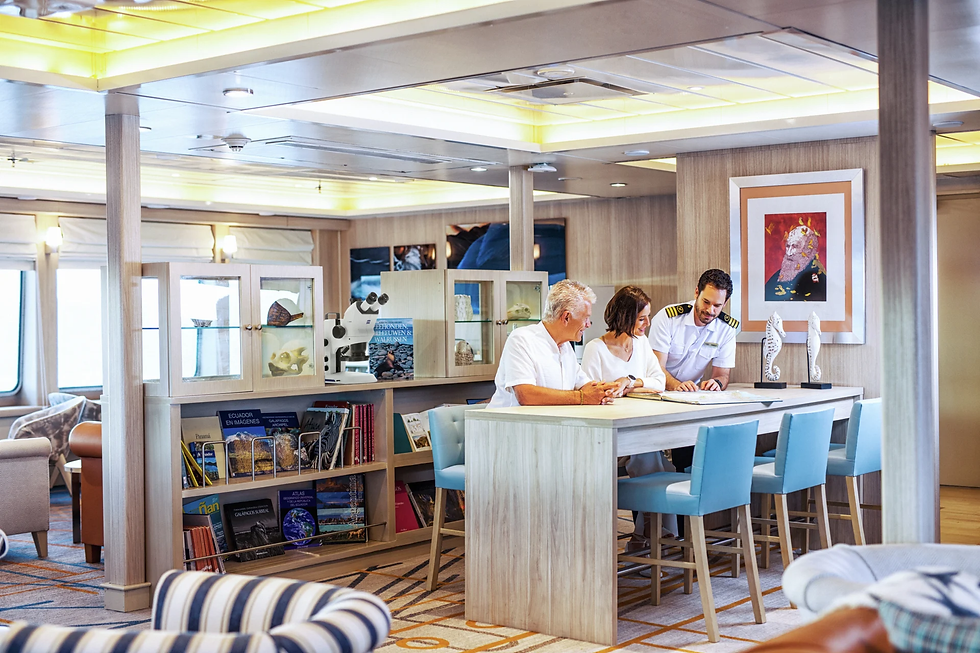
Dress is casual. Universally, on every ship, on every line. Do not pack a dinner jacket.
The days are busier than people expect. A morning landing, back for lunch, an afternoon snorkel or a second landing, a briefing before dinner. It is not a sit-by-the-pool holiday, and if that is what you are after, this is the wrong trip.
All about pangas
In Antarctica and the Kimberley you go ashore by zodiac. In the Galapagos the same boat is called a **panga**, and the drill is much the same.
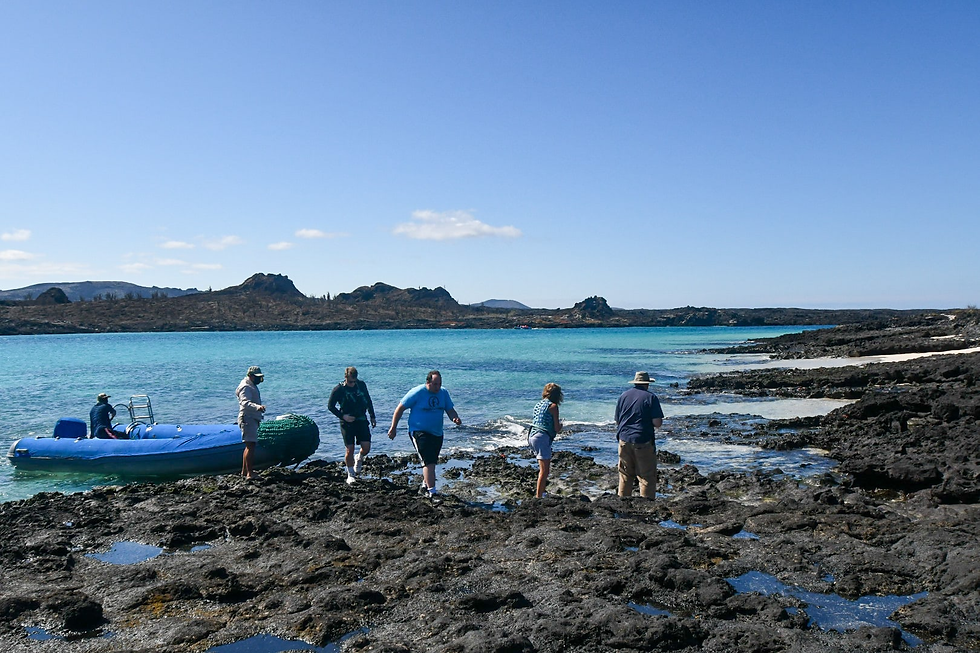
You will step in and out of a small inflatable, often into shallow water, sometimes onto a wet rocky landing. You need to be steady on your feet. If you cannot get in and out of a panga unaided, you will miss the landings, and the landings are the entire reason you came.
Which brings me to the same warning I give for both my other regions, and I will not soften it.
Do not leave this trip until you are too old to enjoy it. I see it constantly. People save the special ones for last and then arrive without the agility to get ashore. The Galapagos is gentler than Antarctica, and the landings are easier, but you still have to be able to move. Go while you can climb into a boat.
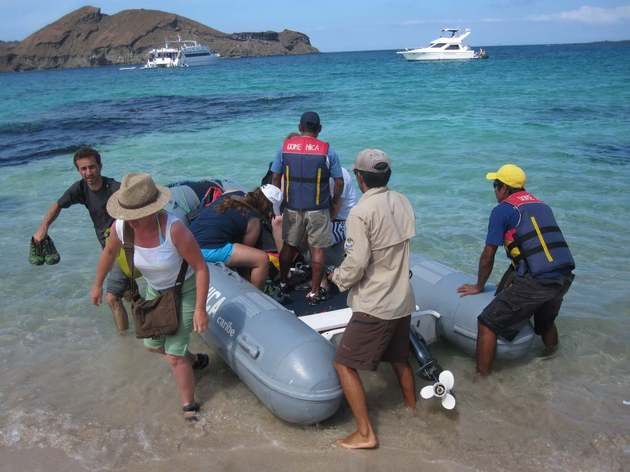
There are two kinds of landing. A **dry landing**, where you step onto rock or a small dock, and a **wet landing**, where you step out into knee-deep water onto a beach. You will do both. Bring shoes that can handle both.
Wildlife
This is why you are going, so let me be specific rather than gushing.
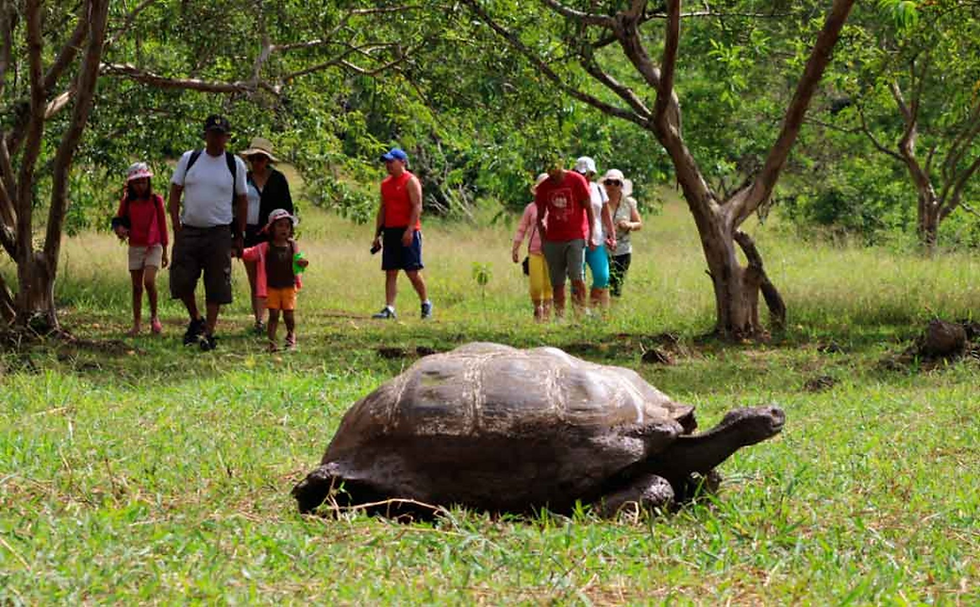
Giant tortoises. The animals the islands are named for. You will see them in the highlands of Santa Cruz and at the breeding centres. Some of them were alive before your grandparents were born.
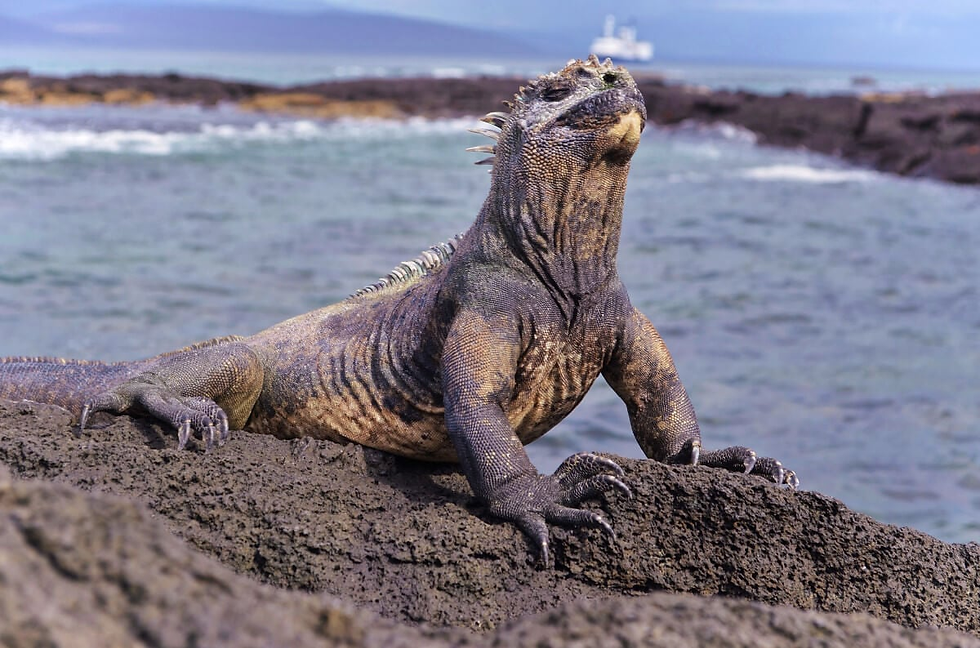
Marine iguanas. Found nowhere else on earth. The only lizard that swims and feeds in the sea. They pile on the black lava rocks in the hundreds and sneeze salt at you.

Blue-footed boobies. The feet really are that blue, and the courtship dance really is that ridiculous. They will perform it right beside the trail and pay you no attention at all.
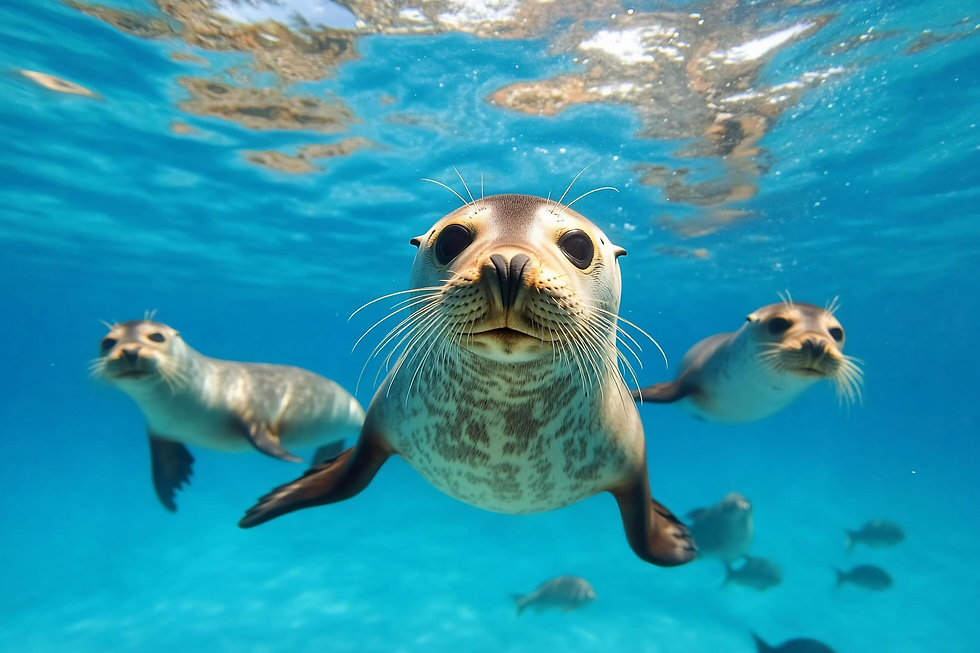
Sea lions. Everywhere. On the beaches, on the rocks, on the benches, occasionally on the dock steps you were hoping to use. They will swim with you when you snorkel and they are far better at it than you are.
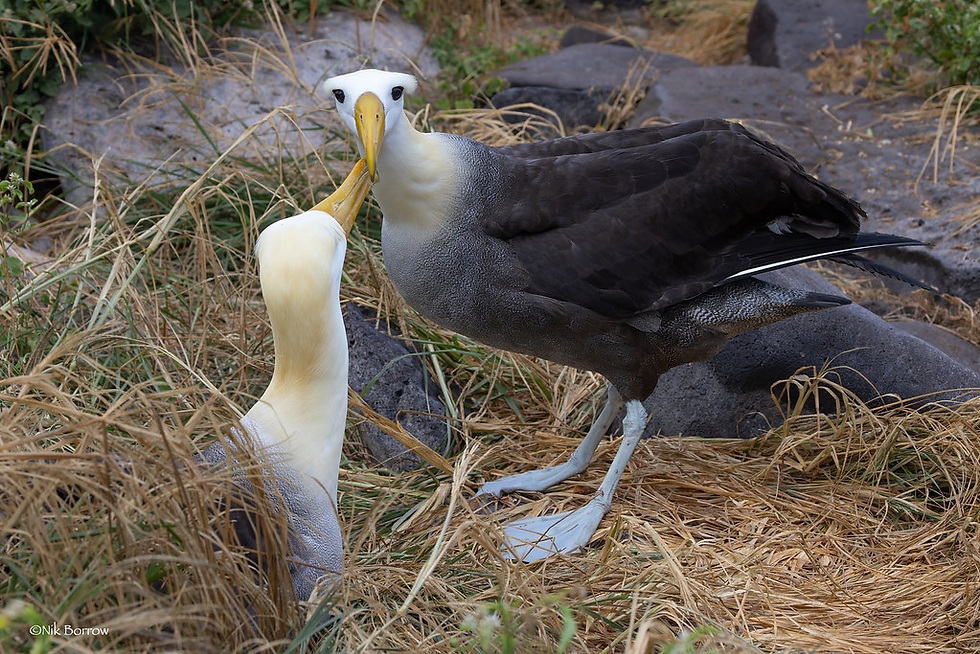
Waved albatross, on Española, and only between roughly April and December. If this bird is on your list, your sailing dates and your itinerary both have to line up.
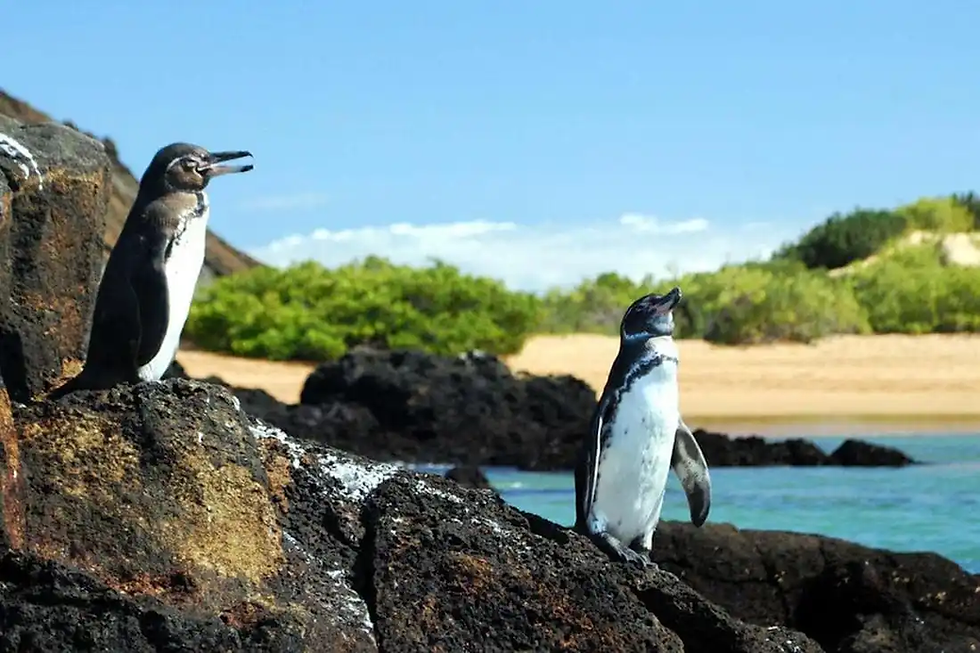
Galapagos penguins. The only penguin found north of the equator. Concentrated in the west, around Isabela and Fernandina.

Flightless cormorant. Another one that exists nowhere else. Evolution took its wings away because it did not need them. Also in the west.
Hammerheads, rays, turtles, reef sharks. In the water, and in numbers, especially in the cool season.
The thing nobody prepares you for is how close it all is. There is no long lens required. There is no waiting in a hide. You walk down a marked trail and the animals simply carry on with their lives around your feet.
The weather
Warm all year, because you are sitting on the equator.
In the warm season expect heat, humidity, strong equatorial sun, and short heavy showers that pass quickly. In the cool season expect milder air, the grey garúa mist in the highlands, and a cooler, choppier sea.
Two things people get wrong.

**The sun.** You are on the equator. The sun here is savage, and it will find you even through the cloud of the garúa. I am an Australian and I do not say that lightly. Hat, long sleeves, and sunscreen, every day, no exceptions.
**The water temperature.** In the cool season the Humboldt Current makes the sea properly cold, cold enough that snorkelling without a wetsuit stops being fun quite quickly. Most ships supply them. Check that yours does before you sail.
Seasickness is rarely an issue in the warm season. In the cool season the crossings between islands can get lumpy. If you are prone to it, take the medication before you feel unwell, not after.
What to pack
The Galapagos is the opposite of Antarctica. You are not packing for cold. You are packing for sun, salt water, and getting in and out of boats.
For landings and excursions
- Wet landing shoes with a heel strap, so they do not come off in the surf
- Comfortable walking shoes for the dry landings and the trails
- Long-sleeved sun shirt with a proper SPF rating
- Broad-brimmed hat, not a baseball cap. A baseball cap will not save your neck or your ears
- Sunglasses with a strap
- Reef-safe sunscreen, and more of it than you think
- Swimwear, and a rash vest
- Small waterproof day pack
- Waterproof phone or camera pouch with a neck strap
- Insect repellent
Onboard
- Casual clothing only. No formal wear on any line
- Light layers for the evenings, particularly in the cool season
- Binoculars if you have them, though most ships supply them
Pack in your carry-on
- Prescription medication
- Spare glasses or contacts
- Seasickness medication
Do not bring
- Drones. Prohibited in the National Park
- Any organic material. Seeds, fruit, plants. Biosecurity here is strict, and rightly so
- Anything you plan to take from the islands. You leave with photographs and nothing else
Which are the best cruise lines
I sell four lines into the Galapagos, and they are very different from one another. This is not a case of four versions of the same product.
Silversea
The luxury end. One ship, the **Silver Origin**, purpose-built for these islands and nothing else. All-suite, all-balcony, a butler, and the highest guide ratio in the archipelago. If you want the Galapagos with the full 6-star treatment and the budget is there, this is the one.
Fares run the widest range of any line I sell here, from around nine thousand US at the low end up into the forties for the top suites on the longer sailings.
Celebrity
The **Celebrity Flora**, and it is a serious ship. Purpose-built, all-suite, all-balcony, and it holds one hundred guests, which is the legal ceiling. Properly luxurious without quite the price of Silversea. This is the sweet spot for a lot of people, and it is where I place more clients than anywhere else.
Lindblad
The naturalist's choice, and by some distance the biggest presence in the islands. Four ships, including the **National Geographic Islander II**, the **Endeavour II**, the **Gemini** and the **Delfina**. The National Geographic partnership is not marketing fluff. The guiding and the photography instruction are the best in the archipelago, and if the wildlife is the whole point of the trip rather than the ship, this is where I would put you.
Range of ships means a range of price points, and there is real value in the fleet if you are flexible about which vessel.
HX
The **Santa Cruz II**. The best value option, and the one I recommend when the budget is the constraint. It is a comfortable ship with good guides, and it will show you the same islands and the same animals as the ships costing twice as much. The suites are smaller and the polish is less. The wildlife could not care less either way.
This is where the lowest fares in the Galapagos live.
Which ships, and how to choose
Ask the same question I tell you to ask everywhere else. **How old is the ship?**
The newer vessels in the islands are markedly better than the older ones. Better stabilisers, which matters in the cool season chop. All-balcony layouts rather than a mix that includes windowless cabins. Better boarding platforms for the pangas, which you will use twice a day, every day.
If you have two options at a similar price on similar dates, take the newer ship. That rule has never once let me down. However when it come to the limited number of operators around the islands, there is greatly reduced choice. The newer ships are operated by Celebrity and Silversea,swisha nd luxurious as they are, for my money, they are only an option if your budget is open ended. Both of these lines will see you paying up to $10 to $15K more for esentially the same expedition experience in the Zodiacs.
The other question, and it matters more here than anywhere: **which islands does this specific sailing visit?** The park sets the itinerary. Two sailings on the same ship in consecutive weeks will go to different places. Do not assume. Check.
Other operators
There are a great many boats operating in the Galapagos beyond the four lines I sell. Dozens of them. Sixteen-passenger yachts, catamarans, older converted vessels, and everything in between.
Some of them are excellent. Truly. A small yacht with a superb naturalist can be a wonderful way to see the islands, and I am not going to pretend otherwise just because I do not sell it.
But understand the trade you are making. On the smaller boats you get less space, fewer public areas, less stable vessels in the cool season swell, and usually one guide rather than a team. Alcohol will not be included. The cabins will be small, and on the older boats a fair number of them have portholes rather than windows.
The four lines I sell are all at the top of the market for a reason, and my job is to get you onto them for less. If your budget simply will not stretch, tell me, and I will tell you honestly whether one of the smaller operators is the better answer for you. I would rather do that than sell you the wrong thing.
More than anything you are a long way from home. Further than you will likley ever be. If anything goes wrong, you need to have the assurnace that you are in safe hands. My preferred operators, HX, Celebrity and Silversea have the backing of big multinational brands. Not only do the they have repuations to protect, they have the resources to get you what ever help might be needed.
Mistakes people make
- Leaving it until you are too old to climb in and out of a panga
- Not checking which islands the specific sailing visits, and missing the one bird or animal you ache to see
- Flying in on the day the ship sails. There is no next port. There is no catching up
- Underestimating the equatorial sun. It is brutal, and the garúa mist will fool you into thinking it is not
- Booking the cool season and not checking whether the ship supplies wetsuits
- Packing formal clothes. There is nowhere to wear them
- Bringing a drone. It will be confiscated
- Forgetting that the National Park fee and transit card are not in your cruise fare
- Booking a ship without checking its age
- Assuming the Galapagos discounts the way Antarctica does. It does not, and anyone promising you an eighty percent discount is telling you a story
- Taking the advice of an agent who has never sold the islands. Ask them which islands the itinerary covers. If they cannot answer, they do not know
- Going without insurance. Same rule as everywhere else I send people
- Not being ready for how close the animals get. It is the thing everyone comes home talking about
Understanding the pricing
Galapagos fares are high for the same reason Kimberley fares are high. The capacity is capped by law, the ships are small, the guide ratios are mandated, and the operating costs cannot be spread across a big passenger count.
Across the four lines I sell, the sailings in my index currently run from around **$5,800 US** at the very bottom, on the value end of the market, up to about **$46,000 US** for the top suites on the longest luxury sailings.
That is an enormous range, and the spread tells you something important. **What you pay in the Galapagos depends far more on which ship and which suite you choose than on when you sail.** The seasonal swing here is nothing like the Kimberley, where July costs a fortune and September does not. In the Galapagos, the ship is the price.
I am not going to publish target buy-at prices for the Galapagos yet.
I publish those for the Kimberley and Antarctica because I have a decade or two of data behind me and I know exactly what a good fare looks like.
I am building that same picture here, week by week, through my Galapagos Price Index, and I would rather tell you nothing than tell you something I cannot stand behind.
What I will tell you is this. The discounts are real, they are just narrower than my other regions, and the best of them turn up on the shoulder months and on the ships that have a cabin to fill. That is what I watch for, and that is what I will find you.
I am happy to run the numbers on any Galapagos deal you have found, any time, free of any obligation. If you have found a good one, I will be the first to tell you so.
Solo travellers
The Galapagos is a good place to travel alone.
You are on a small ship with a small group, doing everything together, twice a day, for a week. It is impossible to stay a stranger. Of all the regions I sell, this is the one where solo travellers have the easiest time of it.
Single supplements vary a great deal by line and by sailing. Some have them, some waive them, and a few of the smaller cabins are priced for one. There is no reliable rule, which means it is worth asking me every single time rather than assuming.
How to secure the best price
Galpaagos Guide + Best Discounts
Cruise fares move like airfares. They rise when a ship is selling and they fall when it is not. Nobody publishes that, and nobody tells you which way a particular sailing is heading.
That is exactly why I built the **Galapagos Price Index**. Every week, I index every Galapagos sailing across all four lines, track what moved up and what moved down, and publish the results. It is free, it is on the website, and you do not have to buy anything to use it.
Select **Index** from the main menu at **www.6star4less.com**. I publish the new results every Sunday.
If you would rather just ask, ask. Tell me the sailing you are looking at and I will tell you what it has done over the past weeks, whether I think it is likely to drop, and whether you should wait or move now. Most agents want the quick sale. I will tell you to hold if holding is the right call.
How to book, or just ask a question
Text is the fastest way to reach me. I answer every message myself.
**SMS or WhatsApp:** +61 430 200 535
**Email:** james@kvi.travel
Text is preferred over a telephone call.
Ask me anything. Which line suits you, which sailing covers the islands you care about, whether a fare you have been quoted is a good one. No obligation, ever.

Read my other guides:


Comments